
A couple of years ago, I played the scariest game I have ever experienced. I had never, that I can remember, needed to physically stand up and walk away from a game to calm my pounding heart, but there’s a first time for everything.
Visage is a psychological horror game that released, officially, on October 30, 2020, although it had a lengthy alpha/beta period before release, with multiple versions existing before the final product. I had first played the game during the early access period, although I only lasted about half an hour before needing a break, telling myself that I would “definitely come back to this later.” It took a few years, but I DID come back to it later!
In Visage, we play as Dwayne Anderson, an apparently extremely disturbed individual given the BRUTAL opening events of the game. Immediately following, Dwayne wakes up on the floor in his home, and we as the player are turned loose into the space and left to wander as we desire. Visage is acutely aware of what it is, and tells the player outright that it is a very difficult game, providing little assistance aside from basic information on its mechanics. Because of this, I genuinely felt like a stranger in what was ostensibly my own home as Dwayne, and didn’t know what the game wanted me to do at this point.
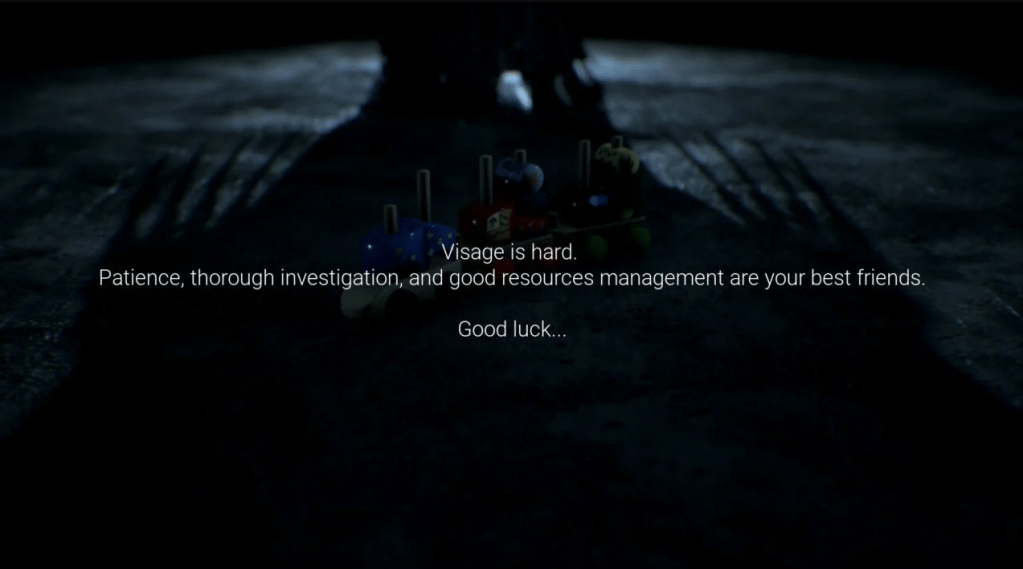
Seriously, it tells you.
It is this lack of information and guidance that was foundational to my overall experience with Visage. The game is actively hostile toward the player, requiring a countdown before the game will pause, having an extremely clunky and limited inventory system, and several sections where saving is disabled. With all of this in mind, it made an otherwise simplistic enemy system far, far more terrifying.
At its core, Visage is what I often (disrespectfully) refer to as a “run-away-and-hide” game, offering few options for disengaging with hostile encounters that aren’t simply running until the encounter ends. I have a love-hate relationship with games like this, because being forced to run does inherently make any game more frightening, but can very easily devolve into a frustrating die-and-repeat experience that instantly kills any fear it was beginning to stir.
Visage managed to walk this line especially well, in my opinion, for two primary reasons:
- Encounters seem genuinely random
- Any room can provide safety, if you’re fast enough
Because a “haunting event” can occur anywhere (outside of specific puzzle segments), any room must become potential safety, which removes the need to find a “good” place to hide if running into danger. In Visage, you simply have to put enough distance between yourself and your pursuer, and then close a door behind you to stop the encounter. The only downside is that Visage, in its hostility, does require that you manually open and close doors. It is not simply one click that does this – the player must click and hold to grab the door handle, and then drag the mouse to physically move the door open or closed. This is extremely difficult to do while being chased, and provides much of the tension in these sequences. The balance comes from any door being a viable exit from a chase.
Visage borrows heavily from the acclaimed Amnesia games, king of the run-away-and-hide genre, for the second half of its core mechanics: a sanity system. Sanity in Visage is a wonderfully aggressive feedback loop, where witnessing a haunting event or standing in darkness will harm your sanity, and as it gets worse, haunting events become more likely to occur. If you don’t address your failing sanity with pills you can find throughout the house, you will become trapped in a hellish cycle of frequent chases.
Now that I’ve established the rules that Visage plays by, I want to get to my actual point: not knowing is the scariest thing imaginable. In horror games, the fastest way to kill the horror is to understand it. Like seeing the zipper on the monster’s costume, once you know the rules, the veneer of fear melts away, and you can operate entirely within those rules.
Visage is hostile. It barely gives any information to the player, and what little it did give me set me up for one of the scariest moments I have ever experienced in the horror medium. The two most important mechanics – sanity and doors – failed me in this moment. I was exploring the house’s finished basement, dimly lit and surrounded by doors leading to utility closets and laundry rooms. My sanity was low, though I had pill bottles… I’m just an inventory hoarder. Lucy, a deceased young girl of age seven or eight, and the primary antagonist for chapter 1 of the game, began manifesting in front of me. I watched with delayed terror, trying to determine if this was a scripted event or an actual haunting, unable to look away from Lucy’s jawless, bloodied face as her white eyes looked back at me. I had my answer as Lucy began to give chase, shambling toward me with arms outstretched, her ragged and labored breathing deafening in my ears.
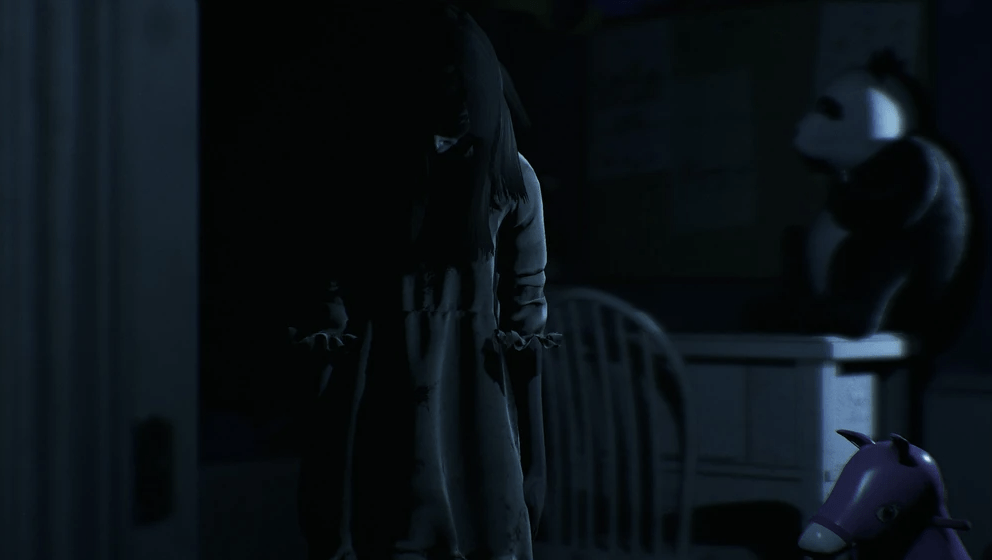
Creepy little girls in horror media don’t scare me. But her…
I sprinted, as much as the game allows, trying to gain distance between myself and Lucy because I knew I had a struggle ahead of me with whatever door I chose to close behind myself. I slipped into a nearby utility closet, and barely shut the door behind myself as Lucy was just inches behind me. I’d done it – I shut the door, the chase was over.
Lucy’s horrible, rattling breath didn’t go away. I could still hear it, loud in my headphones. The door creaked ajar, open just enough to see the black darkness of the hallway. I quickly shut the door again… and again it slowly began to open. I grabbed the door and shut it a third time, and held it shut with my mouse button pressed down.
The game had lied, I thought.
The chase was supposed to be over. I had shut the door, that’s what stops hauntings. Why was she still there? Was there an update I didn’t know about? Was I wrong?
Did I trap myself in a closet with a murderous dead girl on the other side of the door?
I realized my sanity meter (a simple brain icon in the corner of the screen) was dangerously low, and so I rushed to take some pills from my inventory while trying to juggle holding the door closed. As I did… Lucy’s breathing vanished, and the door stopped fighting me. I paused the game (after watching the necessary countdown before it ACTUALLY pauses), stood up, and took a breather as my heart tried to beat out of my chest. That moment was the closest to actual, real panic I’ve felt while playing a horror game, and I play a lot of horror games. The game wasn’t doing what it had told me it would, and that made the terror real.
Ultimately, the game had played by the rules, I just didn’t understand them completely. Lucy wasn’t still outside of the door, as far as I could actually tell. My sanity being as low as it was had caused additional programmed hallucinations – Lucy’s ragged breathing was likely telling me “hey, your sanity is dangerously low!” not that she was still outside of the doorway. Since Visage keeps its rules guarded, and I didn’t actually encounter a substantial amount of chases during my playthrough, I was never given enough information to figure the game out. I interpreted what was happening in that utility closet to be Lucy attempting to reach me despite the chase being over; I thought the rules were being broken, and that’s real fear.
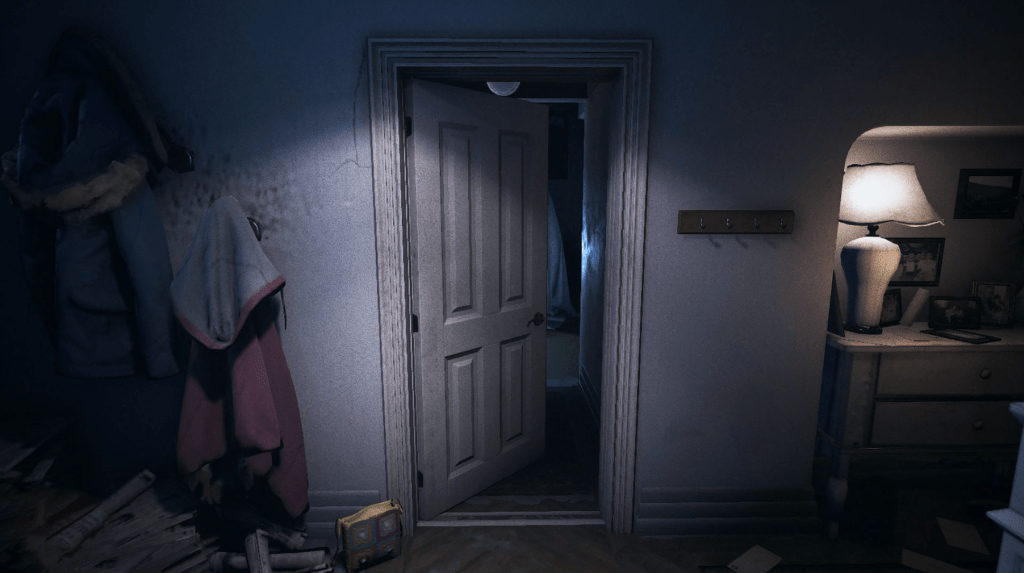
The doors are the scariest enemies, really.
Regarding rules and horror, I recently played an indie horror game called Order 13. It’s a genre of horror game that I’m finding I enjoy, where the game simulates some kind of job or task, and then makes it spooky. In Order 13, you have to print orders from a safe room in a warehouse, and then venture out into the warehouse to pull those items and ship them once back at the safe room. In the warehouse itself is a monster that lurks and wanders – a fairly standard horrific and deformed humanoid thing, and it gives chase if it sees or hears you. When it does, you have to run or hide, and it runs faster than you.
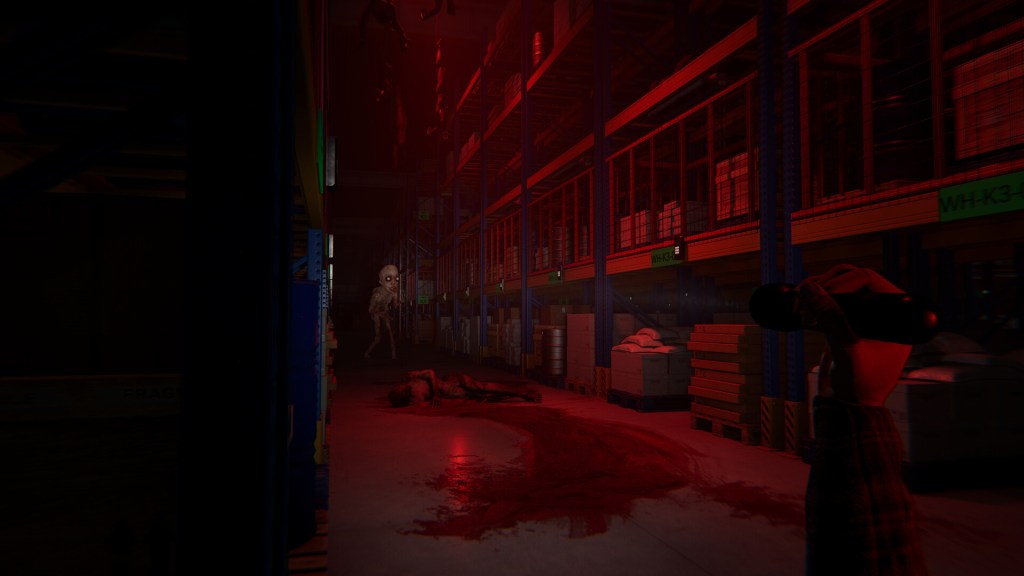
I just pretended he was my boss.
When you hide (underneath warehouse shelving where there’s space) the monster continues to run toward you until reaching your hiding place, and immediately gives up with a frustrated screech before beginning to wander around again. This created a very binary loop of gameplay where, if I was far enough from the monster and knew where some nearby open shelving was, I could always reach 100% safety in time. If I wasn’t far enough from the monster, I simply waited until it wandered from where I needed to be to collect my assigned items.
In contrast with Visage‘s absolutely oppressive atmosphere and murky rules, Order 13 had a very straightforward and easy-to-parse gameplay loop. I really enjoyed Order 13! I also did not find it particularly scary at all, at least not after a few minutes of gameplay. On my first venture out into the warehouse, the warm light and reassuring music of the safe room faded behind me, and I could hear the echoing sounds of the monster somewhere in the darkness of the warehouse. It was in this state of not-knowing, of having no point of reference for the game’s rules, that the game was at its scariest. A huge, dark warehouse with some creature wandering around is an excellent horror setting, but the smallest video game-y inevitabilities whittle away at that horror, such as the limited paths the monster can walk, or its binary behavior depending on whether you’re hiding or in view, until you’ve completely figured out exactly how this game and its monster works… and then it isn’t scary.
Knowing is the death of fear. Of course things can always be frightening to some minimum – being chased, even in a video game, taps into a very primal terror no matter how much you know the rules. Once you know those rules, however, you’ve seen behind the curtain. It is ignorance, the “not-knowing” state that exists early on in most horror games that makes them so much scarier, until you start to recognize the patterns and mathematically solve the game’s horror.
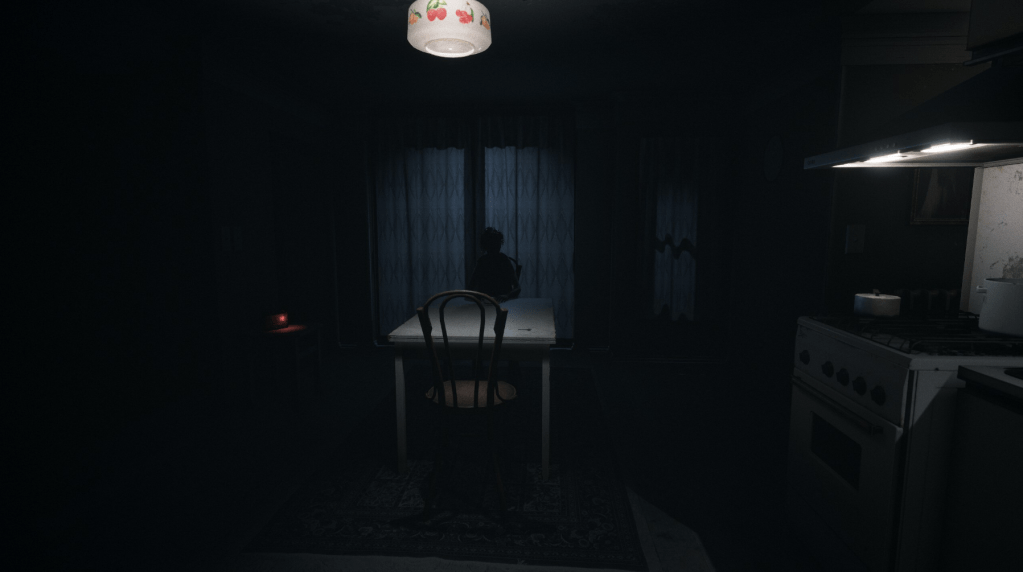
For me, Visage remains one of the scariest games I have ever played for countless reasons, mostly having to do with atmosphere and its setting. Above all else, though, is that Visage is extremely good at ensuring you don’t know. It doesn’t tell you all of the rules, it sometimes behaves in ways that feel like the game is cheating, and is laughing at you as it does. Horror, to me, is not knowing. If I can’t figure out your ghost’s mechanics, the ghost becomes infinitely more terrifying than if I know the rules it plays by, the rules you’ve programmed into the ghost’s code. The amorphous shadow of not knowing, ignorant to the limits and rules of something created to be malicious and to scare me is always the shadow I find myself chasing in horror media.



 Astral's Voyage
Leave a comment